Demystifying IFAB Law 1: The Field of Play – Global Standards vs. The American Soccer Ecosystem

Introduction: Why IFAB Law 1 Dictates Everything on the Soccer Field
In modern soccer, tactical execution, positional rotations, and athletic data tracking do not exist in a vacuum; they are strictly bound by the physical boundaries of the soccer field. IFAB Law 1: The Field of Play is the foundational blueprint of the game. For coaches, referees, players, passionate fans and Colorado Soccer Association, understanding Law 1 goes far beyond knowing that a soccer field is green and rectangular. It dictates how space is manipulated, how transition phases operate, and how the game scales from the elite international stage down to local community complexes.
However, a critical gap often exists in how fans and practitioners perceive the field. When watching major international tournaments such as the World Cup 2026 across the United States, Canada, and Mexico viewers see standardized elite stadiums. But when stepping onto fields locally whether at an adult amateur game in the Colorado Leagues, a high-stakes CHSAA varsity contest, or a youth development match across Front Range complexes the dimensions, markings, and structural applications change dramatically.
1. FIFA Standard: The IFAB Global Blueprint
According to the official International Football Association Board (IFAB) Laws of the Game, Law 1 governs the rigid physical parameters where elite matches take place. The global standard leaves very little room for ambiguity at the professional and international levels.
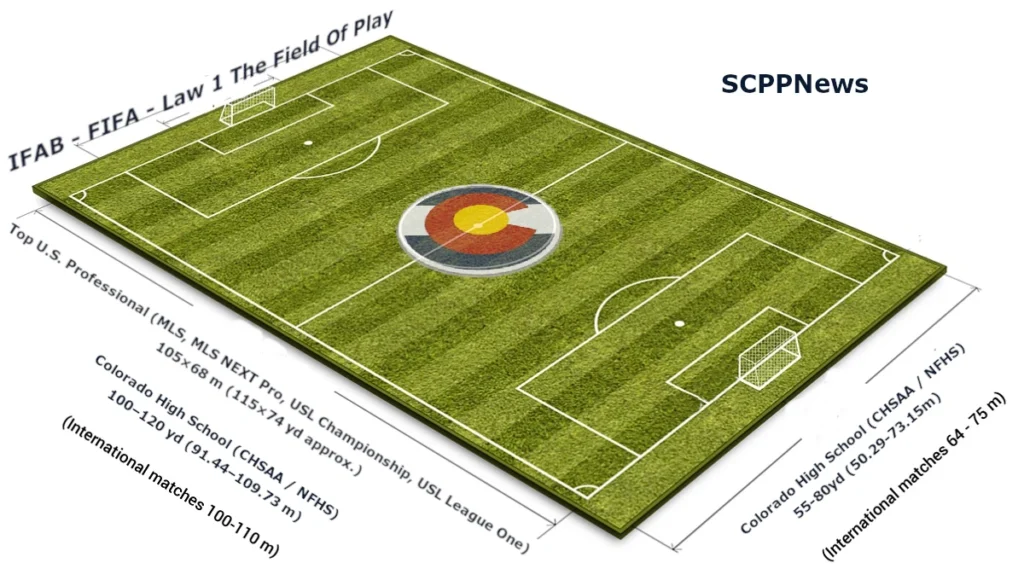
- Elite Field Dimensions: The field of play must be rectangular. For standard professional matches, the touchline must be longer than the goal line. For official international matches under strict FIFA regulations, the length must measure between 100-110m (110-120 yds) and the width between 64-75m (70-80 yds).
- Precision Markings: Every line on a FIFA-standard pitch must be of the exact same width a maximum of 12 cm (5 inches). These consist of boundary lines (touchlines and goal lines), the halfway line, the central circle (with a 9.15m / 10-yard radius), penalty areas, goal areas, and corner arcs. No deceptive or overlapping markings are permitted.
- Goals, Posts, and Nets: Goals must consist of two vertical posts equidistant from the corner flagposts and joined at the top by a horizontal crossbar. Traditional dimensions mandate an exact distance of 7.32m (8 yds) between the posts and 2.44m (8 ft) from the ground to the lower edge of the crossbar. Posts and crossbars must be made of approved materials (wood, metal, or approved composite) and be white in color with specific square, rectangular, round, or elliptical shapes.
2. The American Adaptation: US Soccer & Domestic Play
While North American professional leagues such as Major League Soccer (MLS) strictly adhere to FIFA dimensions, the broader American soccer landscape introduces critical, highly practical structural modifications under US Soccer and domestic sanctioning bodies.
- Youth & Grassroots Scaling: Unlike FIFA’s rigid, one-size-fits-all elite model, American youth structures downsize fields drastically by age group. To accelerate player development, maximize touches on the ball, and enhance tactical cognitive mapping, US Soccer utilizes scaled-down formats such as 4v4, 7v7, and 9v9. A U-9 or U-10 match does not take place on a massive 110-yard pitch; instead, it utilizes modified grid dimensions that force players into quicker decision-making environments.
- High School (CHSAA) & Collegiate Variances: High school play under the Colorado High School Activities Association (CHSAA) and collegiate play under the NCAA implement specific domestic rulebooks (NFHS and NCAA). While they structurally mirror the FIFA blueprint for 11v11 play, they introduce distinct technical area parameters, bench boundaries, and clock management procedures. For instance, collegiate soccer has historically utilized distinct match clocks counting down rather than up, and unique substitution windows that alter how coaches manage the physical space near the touchlines.
3. Tactical Implications: How Law 1 Shapes Coaching and Strategy
Understanding Law 1 is an invaluable asset for tactical analysis. Coaches who study the geometry of the pitch understand that field size directly impacts tactical shapes:
- Compacting vs. Expanding Space: On a narrower or shorter domestic field, teams utilizing a high press can easily suffocate opponent build-up play because the distance from the defensive block to the attacking third is compressed. Conversely, on a maximum-dimension FIFA pitch, wide midfielders and overlapping fullbacks can exploit horizontal channels, forcing defensive structures to stretch laterally.
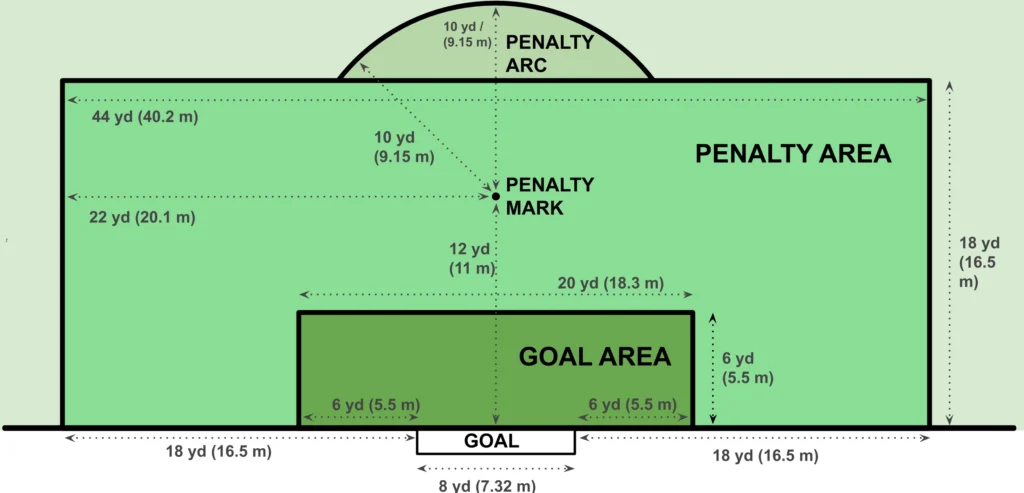
- Set Piece Engineering: Knowing the exact measurements of the penalty area (18 yards out by 6 yards deep) and the goal area allows coaches to design set-piece routines that calculate the exact distance of the defensive wall (10 yards / 9.15m) and optimize runner trajectories into the box.
4. Frequently Asked Questions (FAQ)
- Are all professional soccer fields the exact same size? No. While FIFA recommends a standard size of 105×68 meters for international competitions, stadium architecture allows for variation within the permitted range (100–110m length, 64–75m width). Some historic or modern stadiums feature narrower or wider pitches based on structural limitations.
- Why do youth soccer fields in Colorado vary so much in size? US Soccer mandates age-appropriate field scaling to ensure proper physical load management and technical development for children, ensuring young players are not overwhelmed by adult-sized distances.
- What happens if a goalpost breaks during a match? Under Law 1, if a crossbar or goalpost is broken or displaced, play must be stopped until it is repaired or replaced to its exact regulatory dimensions. If repair is impossible, the match must be abandoned.