Colorado Rapids Hold Off LAFC 1-0 as Home Defense Delivers Another Statement Performance

Colorado Rapids Soccer Club
Return to the full Rapids News Hub Page
COMMERCE CITY, Colo. – LAFC have established themselves as one of the Western Conference’s most stable and efficient sides in 2026, sitting in the top three with 34 points, a +14 goal difference, and a balanced 10‑4‑7 record that reflects both attacking consistency and defensive control. Colorado Rapids, meanwhile, remain a mid‑table team marked by volatility: 28 points from a 9‑1‑10 record and a +5 goal difference show a squad capable of producing wins but unable to maintain rhythm across consecutive fixtures. While LAFC’s season profile signals a strong playoff trajectory built on structure and reliability, the Rapids’ campaign is defined by sporadic peaks and frequent resets, making their ability to “hold off” a top‑performing LAFC side a meaningful result within the broader competitive context.
The atmosphere around DICK’S Sporting Goods Park was building toward a significant Wednesday-night MLS matchup as the Colorado Rapids prepared to face LAFC on August 19, with the official kickoff set for 7:30 p.m. Mountain Time, and the context was important because Colorado entered the game having already produced consecutive home shutout victories against Austin FC and Sporting Kansas City, while LAFC arrived as one of the Western Conference’s top-five teams.
The match was officiated by referee Joe Dickerson, with Brooke Mayo serving as the first assistant referee and Rhett Hammil as the second assistant referee. Jair Marrufo was the fourth official, while Ismir Pekmic served as the Video Assistant Referee (VAR) and Jonathan Johnson as the Assistant Video Assistant Referee (AVAR). Together, the officiating crew managed the match from kickoff through the final whistle, overseeing the decisions and video-review process throughout the Rapids’ 1-0 victory.
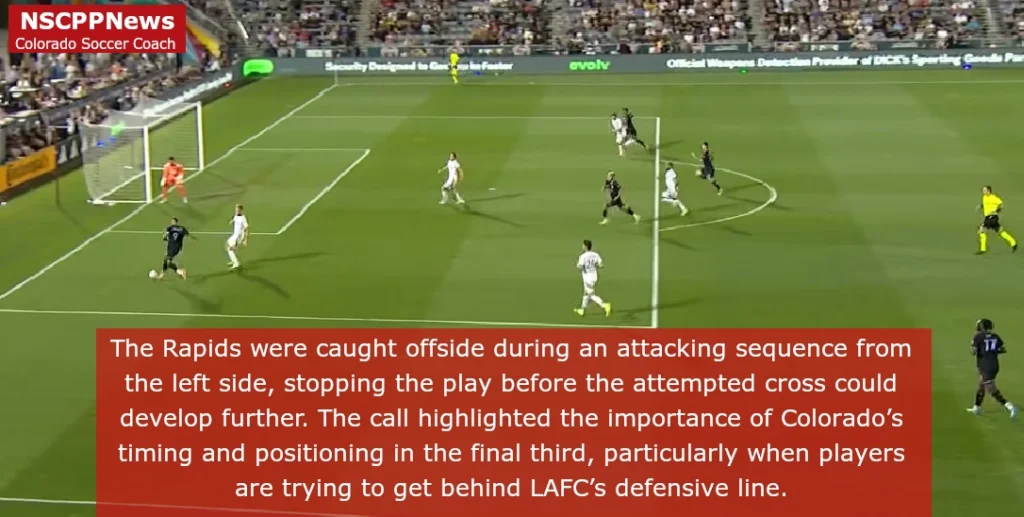
when the referee Joseph Dickerson whistled for the game to start, finally sent both teams into action, Colorado’s starting lineup showed a clear willingness to combine experience with emerging talent, with Nico Hansen in goal behind Reggie Cannon, Loïc Williams, Rob Holding and Miguel Navarro, while Hamzat Ojediran, Wayne Frederick, Paxten Aaronson and Youssef Maziz formed the midfield structure supporting Darren Yapi and captain Rafael Navarro, and the early tactical picture suggested that Colorado was not interested in sitting deep and simply waiting for LAFC to make a mistake, instead looking to establish territory, move the ball forward and use its set pieces as an important attacking weapon, something that made sense after the Rapids had already demonstrated the effectiveness of that approach against Sporting Kansas City four days earlier; the official lineup information also showed Maziz making his first start for Colorado after debuting against Sporting KC, and that decision immediately became relevant because the French midfielder was responsible for one of the night’s most important attacking moments, while the Rapids’ defensive structure had another major responsibility because LAFC possessed the quality to punish even small positional errors, particularly with players such as Denis Bouanga and Son Heung-min available to change the game.
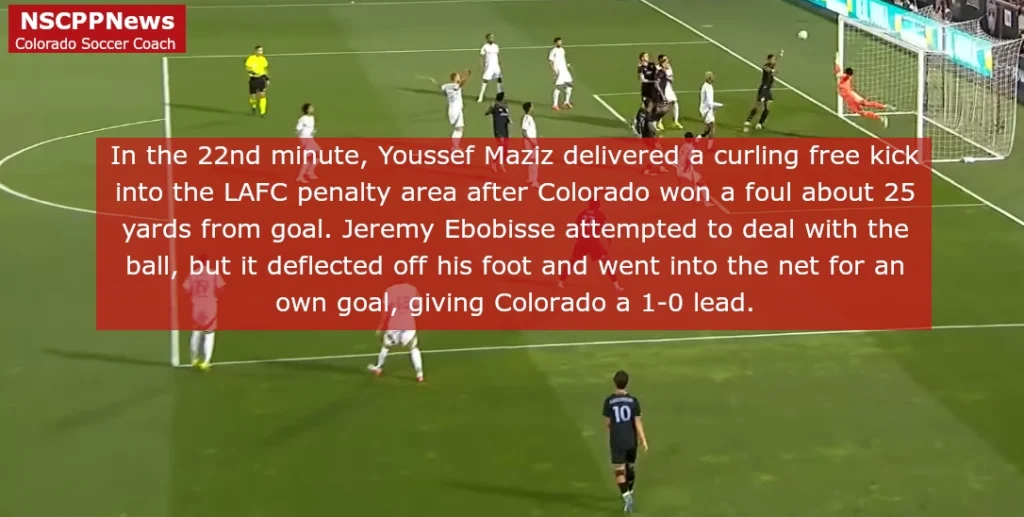
The first major turning point arrived in the 22nd minute, when Colorado won a free kick and Maziz stepped forward to deliver the ball into a dangerous area, creating exactly the type of set-piece situation that can change a closely contested MLS game, but rather than a clean attacking finish from a Rapids player, the ball deflected off LAFC forward Jeremy Ebobisse and ended up in the net for an own goal, giving Colorado a 1-0 advantage; tactically, that goal mattered because it allowed the Rapids to defend from a position of strength rather than chasing the match, and the visitors then had to take greater risks to find an equalizer, while Colorado could concentrate on protecting central spaces and looking for opportunities to attack when LAFC committed players forward, although the home side nearly doubled its advantage before halftime when Rafael Navarro earned a penalty in the 43rd minute, only for LAFC goalkeeper Cabral Carter to dive to his left and keep out the attempt, and Carter then produced another important save in first-half stoppage time when he denied a long-range effort from Maziz, meaning Colorado went into halftime still ahead by only one goal despite having created opportunities to make the margin more comfortable; that sequence also demonstrated why the scoreline alone does not completely describe the match, because the Rapids had found the breakthrough through a set piece, earned a penalty and forced Carter into another difficult save, while LAFC remained within striking distance, and from a tactical perspective the most important question entering the second half was whether Colorado could maintain its defensive concentration once LAFC increased its attacking pressure.
The answer became clear after halftime as LAFC began pushing harder for an equalizer, and one of the most revealing sequences came in the 57th minute when the visitors produced three rapid-fire attempts from inside the penalty area involving Jacob Shaffelburg, Ebobisse and Eddie Segura, with Colorado repeatedly throwing bodies into the danger zone and eventually clearing the threat, a sequence that showed the defensive side of the Rapids’ performance was becoming just as important as the goal that put them ahead; LAFC then introduced Son Heung-min and Denis Bouanga in the 64th minute, raising the attacking threat and creating the kind of late-game pressure that could have changed the outcome, but Colorado continued to protect its advantage, with Hansen and the back line holding their shape while the Rapids worked to prevent LAFC from finding a clean final pass or uncontested shot in the most dangerous areas, and this is where the match became particularly interesting from a coaching perspective because Colorado did not need to dominate possession to control the result, instead its control came through defensive positioning, commitment in the box, blocking shooting lanes and surviving the moments when LAFC increased the tempo; the statistics reinforce that interpretation without requiring exaggeration, because LAFC finished the game without finding the equalizer and Colorado secured another 1-0 home victory, while the Rapids’ official recap identified it as their fourth consecutive home victory with a clean sheet, extending a remarkable recent defensive run at DICK’S Sporting Goods Park, and the result moved Colorado to 9-10-1 with 28 points while LAFC fell to 10-7-4 with 34 points.
When the final whistle sounded, the 1-0 scoreline looked simple, but the game itself offered Colorado something considerably more valuable than a single goal: evidence that the team can win tight MLS matches through defensive organization, set-piece execution and disciplined game management, and the sequence from Maziz’s 22nd-minute free kick to Hansen and the defense protecting the lead against LAFC’s second-half pressure illustrated a team increasingly comfortable playing different phases of the game; there were still areas Colorado could improve, particularly its ability to turn promising attacking moments into a second goal, because relying on a one-goal margin against a team with LAFC’s attacking talent creates unnecessary pressure, but the Rapids showed enough resilience to make the narrow lead stand, and that becomes even more significant considering the short turnaround after their 2-0 victory over Sporting Kansas City on August 15, when Reggie Cannon scored from a Maziz corner and Rafael Navarro added a second goal late in the match; two home games, two victories, five goals scored and zero conceded across those matches provided Colorado with a clear indication that its recent home form is becoming a genuine competitive strength, and the next challenge comes quickly because the Rapids are scheduled to travel to San Diego FC on Saturday, August 22, meaning the real test now is whether the defensive discipline displayed against LAFC can travel with them away from Commerce City, where the environment, game state and tactical demands will be different, but for one Wednesday night in Colorado, the Rapids managed the moments that mattered, protected their advantage and walked away with another home shutout against one of the Western Conference’s strongest opponents.