FIFA-IFAB Law 2: The Ball – Innovations, Colorado Pro vs Youth Scalability, and Game Integrity

Introduction: The Engine of the Soccer Game Across Colorado Pitches
From the high-altitude turf complexes of the Front Range to professional soccer teams, high schools, collegiate, amateur and local soccer clubs training grounds and local recreational soccer fields, every tactical drill, coaching session, and match analysis starts with a single object: the game ball. Law 2: The Ball is often taken for granted, yet it represents a precise intersection of material science, regulatory compliance, and player safety.
For Colorado soccer coach, player, and clubs, understanding the nuances of Law 2 is essential for bridging the gap between global professional standards (such as those seen in international tournaments like the world cup 2026 USA, Canada and Mexico) and the practical realities of domestic play. Whether a Colorado soccer coach is preparing a U-12 academy squad or analyzing regional or professional game footage, recognizing how ball specifications impact technical execution can elevate overall team performance.
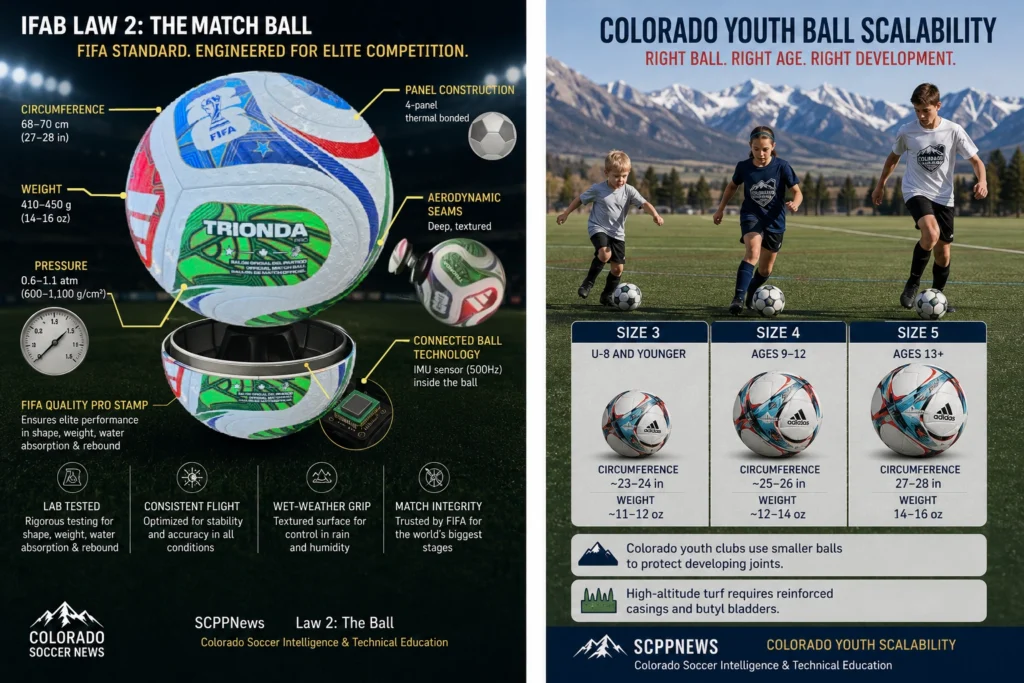
1. FIFA Standard: The IFAB Law 2 & Modern World Cup Technology
Under the official International Football Association Board (IFAB) Laws of the Game, Law 2 mandates that the ball must be spherical, constructed of approved materials, and subjected to rigorous laboratory testing before ever touching an elite pitch.
- Circumference and Weight Parameters: For adult competition (Size 5), the ball must measure between 68 and 70 cm (27 and 28 inches) in circumference. At kickoff, its weight must fall strictly between 410 and 450 g (14 and 16 oz).
- Atmospheric Pressure and Physics: The ball must maintain an air pressure equivalent to 0.6 – 1.1 atmosphere (600 – 1,100 g/cm2) at sea level.
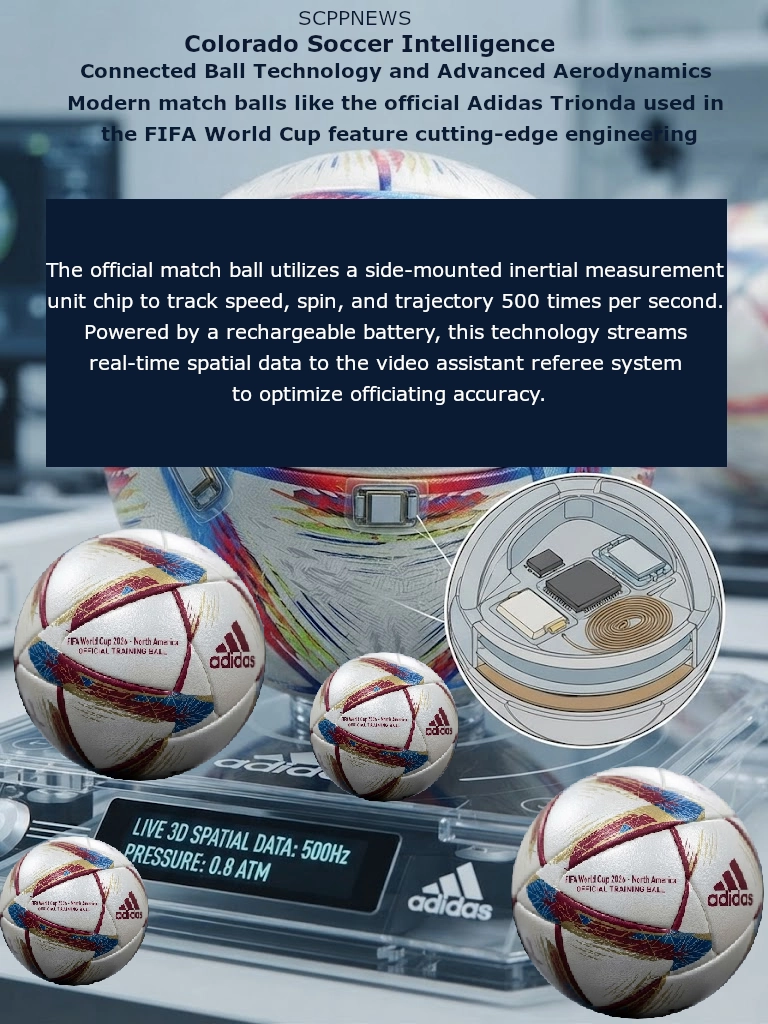
- Connected Ball Technology and Advanced Aerodynamics: At the elite global level, modern match balls like the official Adidas Trionda used in the FIFA World Cup feature cutting-edge engineering. Constructed with an ultra-low four-panel thermal bonding configuration and deep, aerodynamic seams, these modern match balls optimize flight stability and wet-weather grip via textured macro and micro patterns. Furthermore, Connected Ball Technology integrates a state-of-the-art 500Hz inertial measurement unit (IMU) sensor chip inside the panel to transmit real-time 3D spatial and acceleration data to the video assistant referee (VAR) system, revolutionizing semi-automated offside decisions and match officiating.
- The FIFA Quality Tier: Elite professional matches require match balls bearing the official FIFA Quality Pro or FIFA Quality stamp, ensuring rigorous testing for shape retention, weight loss, water absorption, and rebound consistency.
2. Colorado Soccer and the American Adaptation: US Soccer & Domestic Play
While top-tier professional leagues mirror FIFA’s elite specifications, the broader American soccer infrastructure governed by US Soccer, state associations, and scholastic bodies heavily modifies Law 2 to prioritize developmental safety and environmental durability across Colorado soccer fields.
- Age-Appropriate Size Scaling: Colorado youth soccer leagues enforce strict ball-sizing mandates to safeguard developing joints, bone plates, and soft tissue while maximizing technical mastery:
- Size 3: Utilized for U-8 and younger grassroots formats.
- Size 4: Mandated for players ages 9 through 12 across competitive youth clubs.
- Size 5: Introduced exclusively for players aged 13 and older, transitioning into full adult standards.
- Scholastic & Regional Durability (NFHS & NCAA): High school matches overseen by state athletic associations and collegiate games require balls bearing specific governance stamps, such as the NFHS Authenticated mark. Furthermore, because many Colorado fields feature artificial turf or experience high-altitude climate shifts, domestic ball engineering often prioritizes abrasion-resistant outer casings and reinforced butyl bladders to handle harsh sun exposure, synthetic turf friction, and variable weather conditions.
3. Colorado Coaching and Tactical Impact: How Law 2 Drives Technical Development
For any Colorado soccer coach seeking to enhance player intelligence, ball selection and maintenance directly influence training quality and tactical execution:
- Altitude and Flight Dynamics: Operating at high elevations across the Rocky Mountain region affects air density, which subtly alters ball trajectory, drag, and velocity during long-range switching or striking. Training with regulation-pressure balls ensures players develop the correct muscle memory and striking technique suited for local atmospheric conditions.
- First Touch and Surface Adaptation: Technical execution under pressure relies heavily on true rolling and predictable bouncing. Utilizing proper age-scaled sizes ensures that younger players in Colorado academies develop clean mechanics without overextending their ankles or joints trying to manipulate an oversized ball.
4. Frequently Asked Questions (FAQ)
- Can a referee replace a deflated ball mid-game under Law 2? Yes. If a ball bursts or becomes defective during play, the game is stopped. Play is restarted with a dropped ball using the new, inspected ball at the exact spot where the original ball became defective.
- Why do youth soccer players use smaller balls in Colorado leagues? Smaller balls (Size 3 and Size 4) reduce physical strain on young growing joints, lower injury risk, and dramatically improve a player’s ability to cleanly manipulate the ball, leading to higher technical proficiency across Colorado youth clubs.
- Do high-altitude conditions in Colorado change official match ball regulations? While the official IFAB and US Soccer size and pressure rules remain standard, equipment managers and coaches frequently monitor inflation levels closely because pressure can fluctuate with rapid temperature drops and high-altitude barometric shifts.
- What is Connected Ball Technology and is it used in everyday Colorado matches? Connected Ball Technology utilizes a 500Hz motion sensor chip inside the match ball to track precise 3D movements and feed data to the VAR system. While featured prominently in global showcases like the FIFA World Cup, everyday Colorado amateur, collegiate, and youth matches rely on standard FIFA Quality or NFHS-certified balls without tracking chips, though the aerodynamic insights trickle down into modern ball manufacturing.