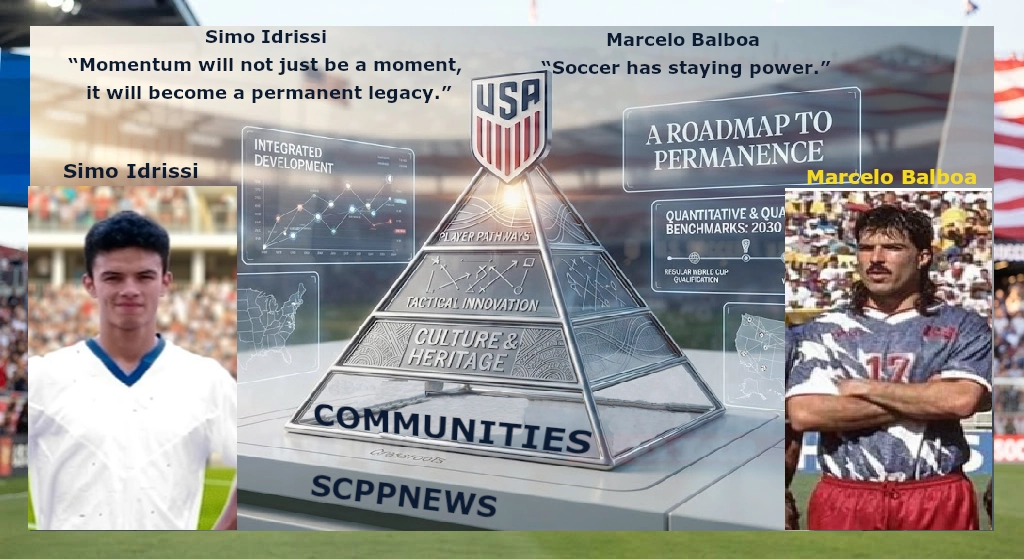
MLS, USL, and USMNT: How Simo Idrissi’s Tactical Vision, Marcelo Balboa’s Legacy, and Troy Renck’s Reporting See America’s Soccer Identity

USMNT Performance and Analysis
Return to the full United States Men's National Team (USMNT) Hub Page
Denver, Co – We are all waiting for that milestone moment: the U.S. Men’s National Soccer Team lifting a World Cup trophy. But the road to that summit raises important questions about how our soccer landscape is truly progressing. There is no doubt that the U.S. Soccer Federation (USSF) and state soccer associations are driving this advancement, but real progress is a collective effort. It belongs to the coaches, the players, the club presidents, and the tireless volunteers who dedicate massive portions of their lives to this game. From our national teams and MLS to the USL, independent leagues and clubs, colleges, and high schools, every level of the pyramid is making a vital contribution to the fabric of American soccer.
While catching up on the latest headlines over coffee, I opened The Denver Post, a platform I hold in high regard alongside our own SCPPNews, and found a compelling piece by a journalist legend Troy Renck. His coverage of our recent World Cup 2026 performance resonated deeply, perfectly capturing the current pulse of the sport in the United States.
The 2026 World Cup has proven what many of us have long suspected: soccer in America has officially crossed the threshold from a niche interest to a major cultural force. When 50 million viewers tune in to support the U.S. Men’s National Team, we are seeing more than just a spike in ratings; we are witnessing the birth of a new American tradition. This moment is not simply about numbers, it is about identity, culture, and the way a sport once considered secondary is now demanding a permanent place at the table of American athletics.
I recently read Renck’s insightful piece in The Denver Post titled, “Renck: Marcelo Balboa knows USMNT missed an opportunity at World Cup, but says soccer ‘has staying power’.” Renck hit the mark when he observed that, for the American consumer, “Futbol became football.” His reporting captured the dual reality of disappointment and triumph: the U.S. Men’s National team fell short against Belgium, but the sheer scale of national engagement revealed a sport that has finally broken through.
This sentiment is echoed by Marcelo Balboa, U.S. soccer legend and former Colorado Rapids star, who highlighted the historic reach of the tournament. Regarding the record-breaking turnout, Balboa told The Denver Post, “Fifty million watching the game shows we are doing something right.” His words carry weight not only because of his legacy as the first American to reach 100 international appearances, but also because they reflect a deep understanding of soccer’s cultural trajectory in the United States.
Balboa’s assertion that the game possesses real “staying power” resonates because it aligns with what we see on the ground in our own communities. The appetite for high-level soccer is no longer theoretical, it is here, and it is hungry for more. It is an exciting time to be an American soccer fan, and we fully agree with the sentiment that our best days are ahead of us.
Yet, as Renck and Balboa both noted, momentum alone is not enough. For soccer to truly embed itself into American culture, the excitement of the World Cup must translate into sustainable growth at every level, from grassroots programs to the professional ranks. To navigate this path, I have turned to the expertise of Simo Idrissi. As a former international soccer player and a coach with a deep history of building elite tactical and structural systems, Idrissi possesses the exact vision needed to transform national hype into long-term professional dominance. His ability to bridge global standards with the unique requirements of the American game makes his perspective essential for shaping our next chapter.
Simo Idrissi’s vision is sharp and ready for professional application: Read the analysis from this Colorado soccer coach.
We have curated three essential questions, inspired by Renck’s article and Balboa’s vision, to guide the conversation forward:
1. USMNT Momentum: How can the national team’s World Cup surge be transformed into long-term growth, ensuring that high-stakes matches lead not only to competitive success but also to a stronger American soccer ecosystem?
Simo Idrissi: “I know for a fact that the U.S. Soccer Federation is working diligently to advance the game, and our state associations are deeply committed to building the infrastructure clubs, coaches, and players that sustains this growth. The 50 million viewers for the USMNT are clear evidence of the foundation we have established.
Momentum, however, must be earned through consistent performance. We must reinforce our player pathways and nurture a soccer culture that is passed down through generations. In Morocco, for example, soccer is a way of life, a deep and personal commitment that begins in the streets and thrives in to the communities. America has a wealth of talent today; the challenge is to broaden our identity and ensure diversity remains a cornerstone of our success.
For our technical staff, the mission is clear: coaching is not just about tactics, but about preparing the individual for the demands of the global stage. We shouldn’t look only at distant horizons; we must focus on the next four years. Today’s 14-year-old talent is our future prime. If we prepare with intent today, this momentum will not just be a moment it will become a permanent legacy.”
2. Grassroots to Professional Pathways: As Balboa emphasized, lasting interest depends on soccer becoming a generational tradition. What infrastructure changes are needed to ensure that World Cup excitement translates into deeper, more consistent support for MLS clubs and the grassroots systems that feed them?
Simo Idrissi: “Indeed, Marcelo Balboa’s point is very important and multifaceted. The issue is closely tied to conviction and a love for the game. All clubs, including those in Major League Soccer (MLS), the United Soccer League (USL), and independent levels below them, are more active on a daily basis today than in previous years, which is clear evidence of development and progress. Winning the FIFA World Cup, or any championship, requires a foundation of cultural heritage and tradition.
If we compare American soccer today to countries with long‑standing professional traditions that have not yet won the World Cup or their continental championship, we see examples such as Belgium, Croatia, and Sweden. Belgium has yet to win either title, Croatia was a runner‑up and finished third, and Sweden also has not won either. Belgium and Sweden both participated in the 2026 FIFA World Cup, co‑hosted by the United States, Canada, and Mexico. Some countries boast prestigious titles, such as Great Britain, which won the World Cup once in 1966, and Spain, which won in 2010. The nations with the most World Cup titles are Brazil with five, Germany with four, Italy with four, and Argentina with three. England has not won the World Cup in 60 years, while Brazil has not won in 24 years.
As for the United States, the men’s national team has reached third place in past World Cup tournaments and advanced to the quarterfinals in the 2002 FIFA World Cup in Japan and South Korea. The USMNT has also won the CONCACAF Gold Cup seven times. This shows the team is very strong and advancing quickly. However, winning the World Cup requires additional effort in cultural, traditional, psychological, physical, and especially mental areas. When all players integrated into the USMNT system arriving from every level of the game in the U.S. reach the level of dynamism needed to make decisions in any situation, then America can demonstrate how to win a World Cup.
In U.S. soccer, there is already a type of unified framework that connects all clubs. I believe advancement will continue, and we will see progress sooner because I trust the American soccer system, the United States Soccer Federation (USSF), and the sports governance structure that runs the game. I can see that the system respects each club’s level of play and identity. The culture, tradition, and sports management in America are excellent, unique, and distinctive, with their own style. I appreciate the style and the framework of regulations. This is very positive at the moment because the country is successful in many matters related to sports governance. To reach and obtain the trophy, however, requires embedding an international winning culture among both players and coaches. By the way, the United States Soccer Federation is very active in sending youth national and regional teams abroad to play in tournaments, and this is a great effort. I believe there are more initiatives to come.”
3. Measuring Progress Toward 2038: With the U.S. considering another World Cup bid, what benchmarks both qualitative and quantitative should the federation adopt to guarantee that by 2038 the national team is not just participating, but consistently competing for titles against the world’s elite?
Simo Idrissi: By 2030 and 2038, I believe the United States already has clear ways of measuring progress, including consistent participation and competitiveness against the world’s elite. The benchmarks are both quantitative and qualitative. On the quantitative side, the United States Soccer Federation (USSF), under leaders such as Cindy Parlow Cone and JT Batson, is surely tracking metrics like regular qualification for the knockout stages of the FIFA World Cup, consistent victories in the CONCACAF Gold Cup, and strong performances in international friendlies and tournaments abroad. Player development pipelines are also measured by the number of youth players advancing from Major League Soccer (MLS), the United Soccer League (USL), and independent academies into the national team. In the last six years, we have seen tremendous growth: instead of just a few academies nationwide, now every state has more than ten, plus MLS and USL youth leagues that were never before participating. This shows real progress in how the system is managed and developed.
On the qualitative side, the federation and associations can continue to emphasize building a winning culture among players and coaches, strengthening mental resilience, and embedding tradition into the game so that soccer becomes a generational inheritance. I believe this is exactly what Marcelo Balboa was pointing to. The system already respects each club’s identity and level of play, but reinforcing pathways and ensuring that every player entering the USMNT system can adapt to high‑pressure decision‑making with innovative tactical patterns as tools of the game will elevate America to the level needed to win.
I also believe the USSF’s active role in sending youth and regional teams abroad is an excellent first step. Expanding these initiatives within the United States, especially by integrating more tournaments that attract larger audiences and emphasize winning among young players, will ensure that by 2030 and 2038 the U.S. is not only present but consistently competing for titles.
Insights from the Field: A Roadmap to Permanence
Don’s Note: After reviewing the analysis provided by Simo Idrissi, it is clear that our path forward is not built on quick fixes, but on the disciplined construction of a winning culture.
Simo Idrissi’s perspective highlights that progress toward 2030 and 2038 must be measured through both quantitative and qualitative benchmarks. On the quantitative side, the United States Soccer Federation (USSF) under leaders like Cindy Parlow Cone and JT Batson is already tracking consistent FIFA World Cup qualifications, victories in the CONCACAF Gold Cup, and the expansion of youth academies across every state through Major League Soccer (MLS), the United Soccer League (USL), and independent programs. This growth in participation reflects a system that is maturing rapidly.
On the qualitative side, Idrissi emphasizes the importance of embedding a winning culture among players and coaches, strengthening mental resilience, and ensuring that tactical innovation becomes part of every player’s toolkit. He notes that the USSF’s initiatives such as sending youth and regional teams abroad are excellent first steps, and expanding these efforts domestically with more competitive tournaments will help instill a generational tradition of soccer.
Taken together, Idrissi’s insights form a roadmap where America’s unique sports governance, cultural identity, and tactical development converge. By reinforcing pathways and cultivating international winning culture, the U.S. can ensure that by 2038 the national team is not only present on the world stage but consistently competing for titles.
The stage is set. Thanks to Renck’s reporting and Balboa’s vision, we know that soccer in America has reached a turning point. Now, with leaders like Idrissi contributing their expertise, it is time to transform this momentum into permanence. The U.S. game has “staying power” and the work ahead will determine how strong that power becomes.