U.S. U-20 Falls 2-0 to Mexico: A Final That Revealed Both the Progress and the Work Ahead

USMNT Performance and Analysis
Return to the full United States Men's National Team (USMNT) Hub Page
The United States Under-19 Men’s National Team did not leave Mexico City with the Concacaf U-20 Championship trophy 08/09/2026, but its 2-0 defeat to Mexico at Estadio Azteca provided something almost as valuable for a developing generation: a clear examination of where American youth soccer currently stands against its biggest regional rival. Mexico deserved the championship after controlling important phases of the match and producing 22 shots compared with six for the United States, but the circumstances of the final also matter. The Americans played the entire second half with 10 players after captain Chris Applewhite’s 45th-minute red card following a VAR review, yet still created several opportunities and finished the tournament having conceded only three goals across six matches. The result therefore should not be reduced to either a failure or an excuse; it was a competitive final that exposed specific areas the U.S. must improve while also showing that this group possesses players capable of competing at a high international level.
The US U20 vs Mexico U20 Game Changed Before the U.S. Could Establish Control
The opening half was relatively balanced, with both teams experiencing periods of possession without producing many clear chances, but Mexico gradually created the more dangerous situations. In the 28th minute, Cristian Inda delivered a free kick toward the far post, where Carlos Hernández redirected the ball and Cristóbal Alfaro eventually forced it over the line; VAR confirmed that the entire ball had crossed the goal line. The sequence deserves particular attention because it was not simply an individual mistake: Mexico used the dead-ball situation to create multiple layers of pressure around the far post, while the U.S. struggled to eliminate the second phase of the play. Colin Guske and goalkeeper Kayne Rizvanovich appeared to keep the ball out initially, but the technology confirmed Mexico had taken the lead.
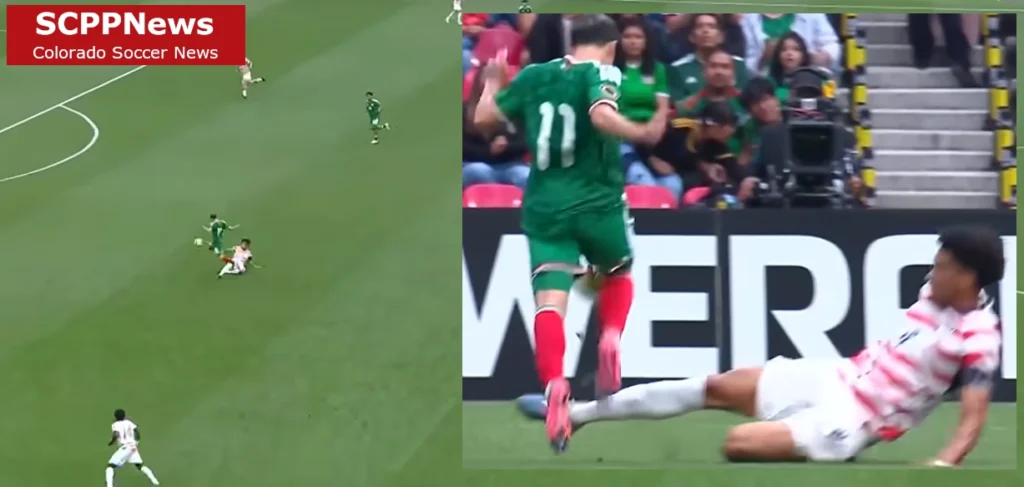
The biggest turning point arrived immediately before halftime. Applewhite initially received a yellow card after a sliding challenge on Hugo Camberos, but VAR determined that he was the last defender and that the foul denied a goalscoring opportunity, changing the punishment to a red card. Whatever debate exists around the contact, the tactical consequence was undeniable: the U.S. entered the second half with 10 players against the tournament host in a stadium containing approximately 36,000 spectators.
🔍 Individual U.S U20 Player Analysis: What the Final Revealed
| # | Player | Position | Match status | Key confirmed statistics/events |
|---|---|---|---|---|
| 1 | Kayne Rizvanovich | GK | Started, 90′ | 2 saves; conceded 2 goals; involved in second-goal sequence |
| 14 | Javaun Mussenden | Defender | Started, subbed 79′ | Replaced by Alexander Shaw |
| 4 | Chris Applewhite (C) | Defender | Started, sent off 45+ | Red card after VAR review; U.S. played second half with 10 |
| 5 | Braden Dunham | Defender | Started, 90′ | Part of defensive unit that conceded 2 |
| 3 | Joshua Torquato | Defender | Started, subbed 68′ | Replaced by Tristan Brown |
| 18 | Xantiago Oyharçabal | Midfielder | Started, subbed 45+3′ | Replaced by Brandon Dayes |
| 6 | Colin Guske | Midfielder | Started, 90′ | Part of central midfield structure |
| 15 | Cooper Sanchez | Midfielder | Started, 90′ | Yellow card, 80′ |
| 7 | Jaidyn Contreras | Forward | Started, 90′ | Created a dangerous attacking action in the second half |
| 9 | Din Klapija | Forward | Started, 90′ | Had the U.S. chance created after Ramos won the attacking duel |
| 17 | Rubén Ramos | Forward | Started, 90′ | Won the attacking-third duel that helped create Klapija’s chance |
| 2 | Brandon Dayes | Midfielder | Entered 45+3′ | Replaced Oyharçabal |
| 13 | Tristan Brown | Defender | Entered 68′ | Replaced Torquato |
| 8 | Alexander Shaw | Defender | Entered 79′ | Replaced Mussenden |
Beyond the final itself, the tournament statistics provide another useful perspective on the U.S. player pool and the workload carried by its core contributors. Rubén Ramos led the United States with 408 minutes, followed by Christopher Cupps and goalkeeper Kayne Rizvanovich with 360 each, Jaidyn Contreras with 355, Chris Applewhite with 338, Alexander Shaw with 331, Colin Guske with 316, Joshua Torquato with 305, and Brandon Dayes with 284, according to available tournament statistics. The final-match roster also included five players who did not enter against Mexico William Lodmell, Lucas McPartlin, Santiago Morales, Dylan Vanney, and Colton Swan while Nimfasha Berchimas and Paulo Rudisill should not be included in the final’s individual analysis because they were not part of the match lineup you provided. This distinction matters because the tournament was larger than the final: evaluating the U.S. generation requires separating players who contributed throughout the competition from those who specifically influenced the championship match.
Mexico’s Biggest Advantage Agaonst U.S. U20: Set Pieces
The most obvious tactical lesson from the final was Mexico’s effectiveness on dead balls.
Both goals came from set-piece situations, and both involved Cristóbal Alfaro attacking the delivery aggressively. The first goal originated from a free kick approximately 30 yards from goal, while the second came from a corner kick. Alfaro ultimately scored both goals, but the deeper lesson is about collective defending: Mexico consistently created situations where one successful delivery could overcome the U.S. defensive structure.
This should become an important area of review for the American coaching staff. At elite international level, matches can be decided by extremely small margins, and set pieces are often where those margins become measurable. The U.S. cannot afford to dominate open-play phases while allowing opponents to create repeated high-quality opportunities from restarts.
Playing With 10: The U.S. Deserves Credit, But Not a Free Pass
The second half demonstrated genuine resilience from the Americans. The U.S. did not simply retreat and accept defeat; it created turnovers, competed for individual duels, and generated attacking opportunities despite the numerical disadvantage. Contreras’s run and Ramos’s duel leading to Klapija’s chance were two examples of the team continuing to search for an equalizer rather than abandoning its attacking mentality.
But resilience should not obscure the underlying performance. Mexico finished with 22 shots to the United States’ six and five shots on target to zero. Those numbers indicate that Mexico controlled the attacking volume, and the American team never produced a shot on target in the final. Playing a man down explains much of that disparity, but it does not explain everything. The next developmental step is learning how to remain dangerous while defending compactly and managing possession more effectively under pressure.
Gonzalo Segares and the Development Challenge
Head coach Gonzalo Segares now has an important development cycle ahead of him. The immediate result was disappointing, but the tournament provided a substantial competitive foundation: the United States reached its fifth consecutive Concacaf U-20 final and qualified for the 2027 FIFA U-20 World Cup and the 2027 Pan American Games. The semifinal qualification also secured the U.S. a place in the next U-20 World Cup, while Mexico earned the Concacaf Olympic berth because the United States is already qualified for Los Angeles 2028 as host.
The next objective should therefore be development rather than simply revenge against Mexico. The U.S. needs to improve its set-piece defending, decision-making under pressure, attacking efficiency, and ability to control matches against opponents capable of changing the rhythm of play.
The Bigger Picture: This Generation Still Has Time
The final result should be placed within the context of the entire tournament. The United States reached its 11th Concacaf U-20 final and its fifth consecutive final appearance, while conceding only three goals across six matches. That consistency demonstrates that the American youth structure is producing teams capable of reaching the highest levels of regional competition, even though Mexico has now won the last two finals between the countries.
For the players, the most important question is what happens next. A championship final is not the end of development; it is another evaluation point. Applewhite must learn from the red card, Rizvanovich from the second goal, the defensive unit from the set pieces, the midfielders from Mexico’s ability to control territory, and the attackers from the difficulty of producing shots on target against a disciplined opponent.
A Thoughtful Question for Simo Idrissi
Simo Idrissi, based on everything we saw the resilience, the structure, the mentality do you believe this U‑20 group reflects the new identity of American soccer: confident, creative, and unafraid of big moments?
I am not sure what do you mean by ‘the new identity of American soccer’. America already established an identity, each player in the United States carries years of information, experience and knowledge so the identity is there. I like US players from recreation to professional. Why I am saying this, because all players now have a different ways of expressing themselves on the field. What may enhance this identity or weaken it is the gameday. When I watched the final, I see all players fought, played, penetrated, possessioned and tried many things to score.
However the only thing I see that wasn’t enough, is when players matching is not accurate. We don’t put a player on that position and give him a role just because he did great in previous games but we also never exaggerate the power of the opposite. If I want to set up players on their positions I have to see if those players fit the skills needed to face the same measurement of the opponent.