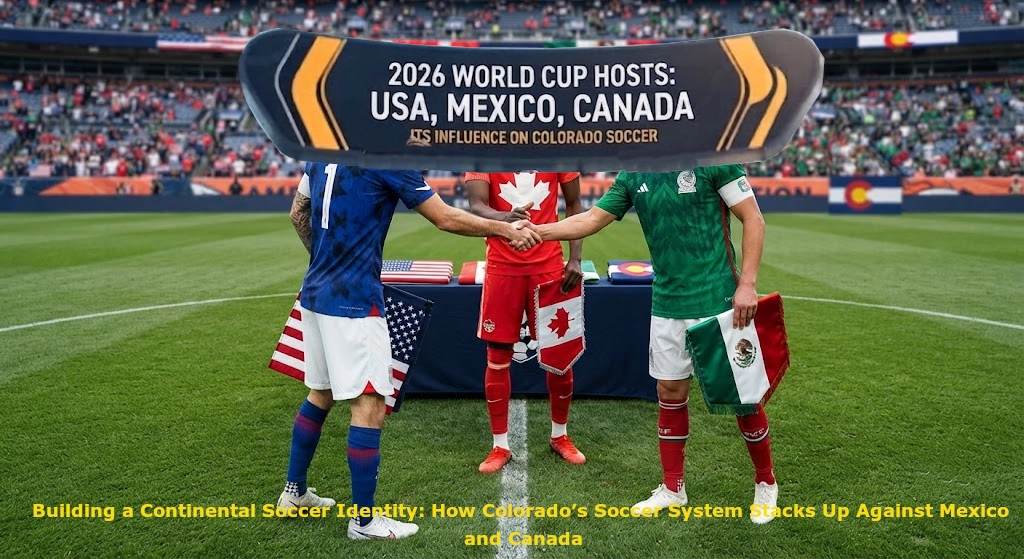
Building a Continental Soccer Identity: How Colorado’s Soccer System Stacks Up Against Mexico and Canada

Denver, CO – With the 2026 World Cup nearing its successful conclusion, the tournament has displayed strong competition and how all national teams have shown resilience and high performance. We now have semifinals between France vs Spain and England vs Argentina. These four teams have been compact and determined to reach this level of play. Each of these four teams features star players: France has Kylian Mbappé, Michael Olise, Ousmane Dembélé, and Adrien Rabiot; Spain has Mikel Oyarzabal, Mikel Merino, Lamine Yamal, and Rodrigo Hernández Cascante; England has Jude Victor William Bellingham, Harry Edward Kane, Bukayo Ayoyinka Temidayo Saka, Declan Rice, Anthony Michael Gordon, and Jordan Lee Pickford; and Argentina has Lionel Andrés Messi Cuccittini, Julián Álvarez, Alexis Mac Allister, Lautaro Javier Martínez, Enzo Jeremías Fernández, Damián Emiliano Martínez Romero, Lisandro Martínez, and Cristian Gabriel Romero.
The USA, Canada, and Mexico 2026 World Cup was and still can be considered not only successful but well-organized and well-introduced. The spectator statistics show Russia 2018 with 3,031,768 spectators, Qatar 2022 with 3,404,252 spectators, and the 2026 World Cup with 6,527,410 spectators more than half again as many as previous tournaments. We still have four games remaining: two semifinals, one for third place, and the final. All these four games will have strong audiences both on the field and through media outlets. Currently, the media is very active because each national team that played can bring at least 60 percent of their nation to watch the game. One big thing that has been displayed is that this is the only World Cup that has had no issues, even though many spoke out saying things that didn’t happen. We noticed many volunteers helped, along with many workers. Each stadium had the correct security personnel. They also had flexibility in how spectators entered the fields, found their seats, and exited after the game ended. There were no overcrowding or pedestrian issues. All fields ingeniously allowed the big crowds to exit without any issues and in just a few minutes.
The World Cup 2026 has now left a lasting imprint on North American soccer. With the United States, Mexico, and Canada having co-hosted the tournament, the moment is right to examine how each nation’s soccer ecosystem is developing not through criticism, but through clear-eyed comparison and shared learning. While Mexico enters with decades of Liga MX tradition and passionate fan culture, Canada has shown rapid professional growth through the Canadian Premier League and strong national team performances.
We aim to focus on Colorado soccer, Colorado soccer coaches, and Colorado soccer players because SCPPNews is Colorado soccer news. These are the most Colorado soccer news we spoke about on SCPPNews, but today the news about Colorado, as a key hub in the U.S. system, offers a compelling case study of structured, community-driven progress that blends American sports governance with global influences. To explore these dynamics, I sat down with two respected USSF A-licensed coaches: Simo Idrissi, a Moroccan-American coach with extensive experience in Colorado’s club and college soccer systems and also working with SCPPNews as game analyzer and news adviser when it comes to true and genuine news that has a technical eye we rely on Simo Idrissi. He voluntarily works and makes a big help for us all. We have a new guest today, Jack Gooden, a seasoned coach known for his work in player development pathways.
Rafael Gonzalez: Gentlemen, thank you for joining me. I have always wanted to sit and have a coffee with Simo Idrissi and here we are today face to face and introduced each other. I also met Jack Gooden great personality and by the way Jack Gooden is a dear friend of Simo Idrissi, but the invitation was random and Jack picked to give us his perspective. Just for our readers, we always use LinkedIn or any other social media to pick coaches and send them messages to answer and put it on our articles or invite them to have a coffee and answer our questions. So, let’s start with the big picture. How would you compare the strengths of soccer development in Colorado, Mexico, and Canada today?
Simo Idrissi: Thank you for having us. Yes Jack is my friend. Long time ago we’ve met in conferences and even games. We worked together on an amateur team that is helping locals play soccer and through this team actually we met the best and great young men. Jack was always supportive to the team. Now, Mexico you mentioned this great country and I remember I have a friend his name Oussama Idrissi and he plays as a winger for CF Pachuca. Mexico, in my knowledge has a tremendous advantage in cultural depth soccer is embedded in daily life from the streets to professional academies almost the same way as Morocco does. Their Liga MX clubs invest heavily in youth structures, and the sheer volume of talent produced is impressive. Canada has made remarkable strides in a shorter time, building professional infrastructure through CPL teams and strong provincial programs that emphasize organized player pathways.
In Colorado, we benefit from the United States’ soccer structured governance. We have clear licensing pathways through United States Soccer Federation (USSF), United Soccer Coaches (USC). The USC has conventions and their certificate will be accepted by USSF or European soccer coaching system. We have excellent college integration via programs like Colorado School of Mines where I had a chance to coach with them and I got to meet great players and staff. While we played the league all games presented great people from all other universities like Denver, Fort Collins, Colorado Springs and around Colorado. Of course Colorado has many great universities where many students nationally and internationally intend to attend those educational systems. We also have many high schools that also now have leveled up so each high school has great teams and great championships and tournaments and a growing network of MLS Next Pro, MLS Next and USL academies without forgetting all local soccer clubs that really enhanced their existence and culture. I love soccer culture in the United States it is unique and has a meaningful system that works for all young and adults. Our strength lies in systematic organization and access to resources across public and private sectors.
Jack Gooden:I completely agree with Simo. I am hoping to see him on any professional level, he deserves to be on those levels. Simo Idrissi is a great guy and intelligent to run any level in my perspective. I learned from him a lot and I know that his humble heart is what made him humble but ask him and you will learn or give him a leadership and he will show you the exact winning culture. I can’t say enough whatever I say but this great person should have a place with professionals and I am sure many coaches who know Simo Idrissi will say the same. Ok, what stands out in Colorado is the respect for each level of the pyramid from recreational clubs and high school programs all the way to professional academies. We have strong state association support that helps standardize coaching education. Mexico excels in raw passion and tactical creativity developed through street soccer and intense competition. Canada has shown smart investment in facilities and coach development, especially in provinces like Ontario and British Columbia. The common thread is that all three regions are moving toward better integration between youth and senior levels.
Rafael Gonzalez: Can you highlight specific areas where Colorado is performing well and where inspiration can be drawn from our neighbors?
Simo Idrissi: Colorado is doing very well in creating multiple pathways. We have increased the number of quality academies across the state, and the collaboration between clubs, colleges, and professional teams continues to improve. Our daily intense programs are fit and I think very high that can compare with Mexico. I am sure that we can progress more but we have a certain diversity that each one has demanding needs so we can say soccer in Colorado now is developed to a level where each player can see better results. Of course Mexico has intense daily soccer environments and fostering that deep emotional connection to the game from a young age the same way as the United States and especially Colorado. Mexican national teams under-17 and under-20 successes often come from this cultural immersion. Canada has done an excellent job in recent years with targeted investment in winter training facilities and national identification programs. We can adopt some of their best practices in cold-weather development and long-term athletic monitoring.
Jack Gooden: Exactly. One area Colorado is advancing quickly is coach education and licensing. The USSF A license process is rigorous and focuses on both tactical understanding and player-centered development. We can continue building on that I believe the progression is on its correct path. Through my friends most are coaches shared with me that Mexico’s creativity in small-sided games is clear and Canada’s emphasis on sports science and data-driven decisions are on their way to success. I know Simo Idrissi has this side of sport science too especially I like when he emphasizes on mental development of youth and adult soccer players. The goal is not to copy any system entirely, but to blend the best elements passion and culture. Structured innovation from Canada, and organizational strength here in the U.S.
Rafael Gonzalez: Looking ahead to 2038, what does sustainable progress look like across these three nations?
Simo Idrissi: Sustainable progress means creating generational soccer cultures. I also believe that winning culture is the right path that can help every player understands how to feel responsibility to accomplish any goal. In Colorado and across the U.S., we need to keep expanding access and keep raising standards. For Mexico I only know that they already have a base but still our continent should bring one day the World Cup. Canada is proving that smart, consistent investment yields results. Through coach exchanges, player development, tournaments, I mean real games and development camps North American soccer as a whole will rise. And I am sure that Colorado is on its path to reach such level.
Jack Gooden: I would add that success will come from focusing on the individual player. Whether in Denver, Mexico City, or Toronto, we need coaches who develop technical skill, tactical intelligence, mental resilience, and love for the game. Colorado has the infrastructure to be a strong contributor to the U.S. system, and we are excited to keep learning from our Canadian and Mexican colleagues while offering our own best practices in return. And I agree with Simo, we have to see one of our continent gets the trophy high.
Rafael Gonzalez: Thank you both. The 2026 World Cup showed and is still showing that North America is ready to compete on the global stage. The real work now is in the daily commitment at every level from grassroots fields in Colorado to academies across Mexico and Canada. The future looks bright when we build together.