USWNT Prepares for Two High-Stakes Friendlies Against Spain as World Cup Qualifying Nears
On Aug 2, 2026
John Wahl 32 Articles
📊 64👁 51
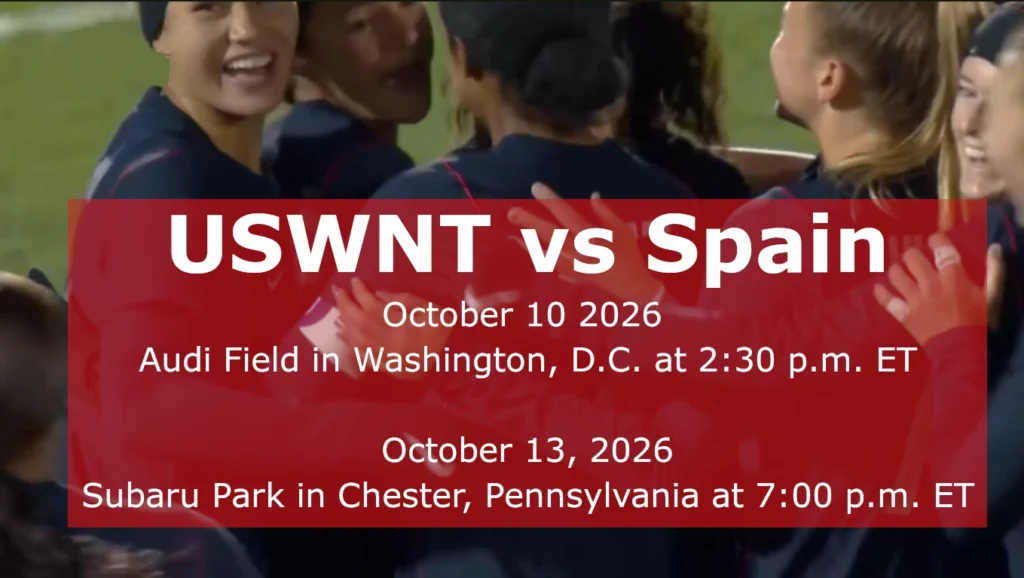
The U.S. Women’s National Team has reached an important stage in its preparation for the 2027 FIFA Women’s World Cup. After spending much of 2026 evaluating new players, testing different tactical systems, and rebuilding the squad under head coach Emma Hayes, the team now faces what could be its most significant challenge before competitive games begin. In October, the United States will play two friendlies against Spain, the reigning FIFA Women’s World Cup champions and the current No. 1-ranked team in the world. The matches will be played on Oct. 10 at Audi Field in Washington, D.C., and on Oct. 13 at Subaru Park in Chester, Pennsylvania. (U.S. Soccer)
While these are officially friendly matches, neither side is expected to treat them as ordinary exhibitions. One question naturally comes to mind: Why are these friendly matches against Spain so important? To better understand their purpose, I reached out to Colorado coach and SCPPNews soccer analyst Simo Idrissi for his perspective.
Speaking about the role of international friendlies, Idrissi explained that these matches are designed to evaluate players in ways that official competitions often cannot.
“The goal of these matches is to gauge the tempo and identify key squad members by assessing each player’s individual level. We don’t necessarily use the same tactics that we would in a competitive tournament. Instead, we create specific game plans that allow us to see how players respond in different situations. For example, if we want to evaluate how players react against an aggressive high press, we may design the match around that objective. Even though these are friendly matches, they are still competitive football games, and U.S. national team fans are going to enjoy watching them.” Idrissi said.
Idrissi’s explanation highlights an important point about international soccer. Friendly matches are not simply warm-up games or opportunities to entertain supporters. For the coaching staff, they serve as controlled testing environments where players, partnerships, and tactical ideas can be evaluated under match conditions without revealing the team’s complete strategy before major tournaments. In that sense, the upcoming matches against Spain are expected to provide valuable information for Emma Hayes and her staff as they continue preparing the USWNT for World Cup qualifying and, ultimately, the 2027 FIFA Women’s World Cup.
For the United States, they represent the final opportunity to measure progress before entering the 2026 Concacaf W Championship, the tournament that serves as qualification for the 2027 FIFA Women’s World Cup in Brazil. Emma Hayes has repeatedly emphasized that every decision made this year has been focused on preparing her squad for that challenge rather than chasing short-term results. (U.S. Soccer)
Hayes inherited one of the world’s most successful national teams, but she also inherited a squad entering a period of transition. Several veteran players have moved on, younger players have stepped into larger roles, and the coaching staff has spent the past year identifying combinations that can compete consistently against the world’s elite nations. Instead of selecting the same starting lineup every international window, Hayes has rotated players across multiple positions, giving opportunities to experienced veterans alongside emerging talent from the National Women’s Soccer League and European clubs. That approach has allowed the coaching staff to evaluate depth while building competition for places ahead of World Cup qualifying. (U.S. Soccer)
Spain presents exactly the type of opponent the United States needs at this stage of its development. Over the last several years, Spain has established itself as one of the strongest teams in women’s soccer through a possession-based style built on technical quality, intelligent movement, and patience in possession. Their midfield often controls the tempo of matches, forcing opponents to defend for long periods before creating openings in the final third. Facing a team with those characteristics will test every part of the American game, from defensive organization to pressing and ball retention. (U.S. Soccer)
The tactical battle between the two nations could become one of the most interesting aspects of the series. The United States has traditionally relied on athleticism, quick transitions, aggressive pressing, and direct attacking play. Under Hayes, however, the team has shown greater flexibility. Rather than pressing at every opportunity, the Americans have demonstrated an increased willingness to build attacks patiently from the back, maintain possession for longer periods, and adjust their defensive shape depending on the opponent. Spain’s ability to dominate possession will provide an ideal test of whether those tactical adjustments can succeed against the world’s best. (U.S. Soccer)
Another important objective for Hayes will be evaluating how her players respond under pressure. Friendlies against lower-ranked opponents often allow coaches to experiment without significant consequences, but matches against Spain are likely to resemble the intensity of a World Cup knockout match. Every defensive mistake can be punished, and every opportunity in front of goal becomes valuable. Those are the types of situations players will encounter during World Cup qualifying and eventually at the 2027 tournament.
The timing of these matches is equally significant. Following the October friendlies, the United States will shift its attention toward the Concacaf W Championship later in the year. Success in that tournament is essential because it provides the pathway to the 2027 FIFA Women’s World Cup. Rather than viewing Spain as the final destination, Hayes and her staff are treating the two matches as the final examination before competitive soccer begins again. (U.S. Soccer)
There is also historical significance attached to the meeting. Although both countries have become global powers in women’s soccer, opportunities to face one another have been relatively limited. The last meeting in Spain ended with a 2-0 victory for the hosts in October 2022, the only win Spain has recorded against the United States. Since then, both programs have changed considerably. Spain captured its first FIFA Women’s World Cup title, while the United States rebounded from disappointment at the 2023 World Cup by winning the Olympic gold medal under Hayes. The October series will therefore feature two teams that have evolved into different versions of themselves. (U.S. Soccer)
Beyond tactics and results, these friendlies also provide an opportunity for the coaching staff to strengthen chemistry within the squad. International windows are short, leaving limited time for players to train together before matches. Building communication between defenders, establishing partnerships in midfield, and improving movement in attack all require repeated experiences against elite competition. Spain offers exactly that environment.
For supporters, the matches promise to showcase two of the strongest women’s national teams in the world. For the coaching staff, they are an opportunity to answer important questions before qualification begins. Which players have earned starting roles? Which tactical approach works best against possession-dominant opponents? Can the team maintain defensive discipline while still creating attacking chances?
Those questions cannot be fully answered on the training field. They require matches against world-class opposition.
As the road to Brazil 2027 becomes shorter, the United States is entering a decisive period. The objective is no longer simply to evaluate talent or experiment with lineups. It is to build a team capable of competing for another World Cup title. The two October friendlies against Spain will not determine whether the United States reaches that goal, but they may reveal how close the USWNT is to becoming a championship-winning team once again. (U.S. Soccer)